



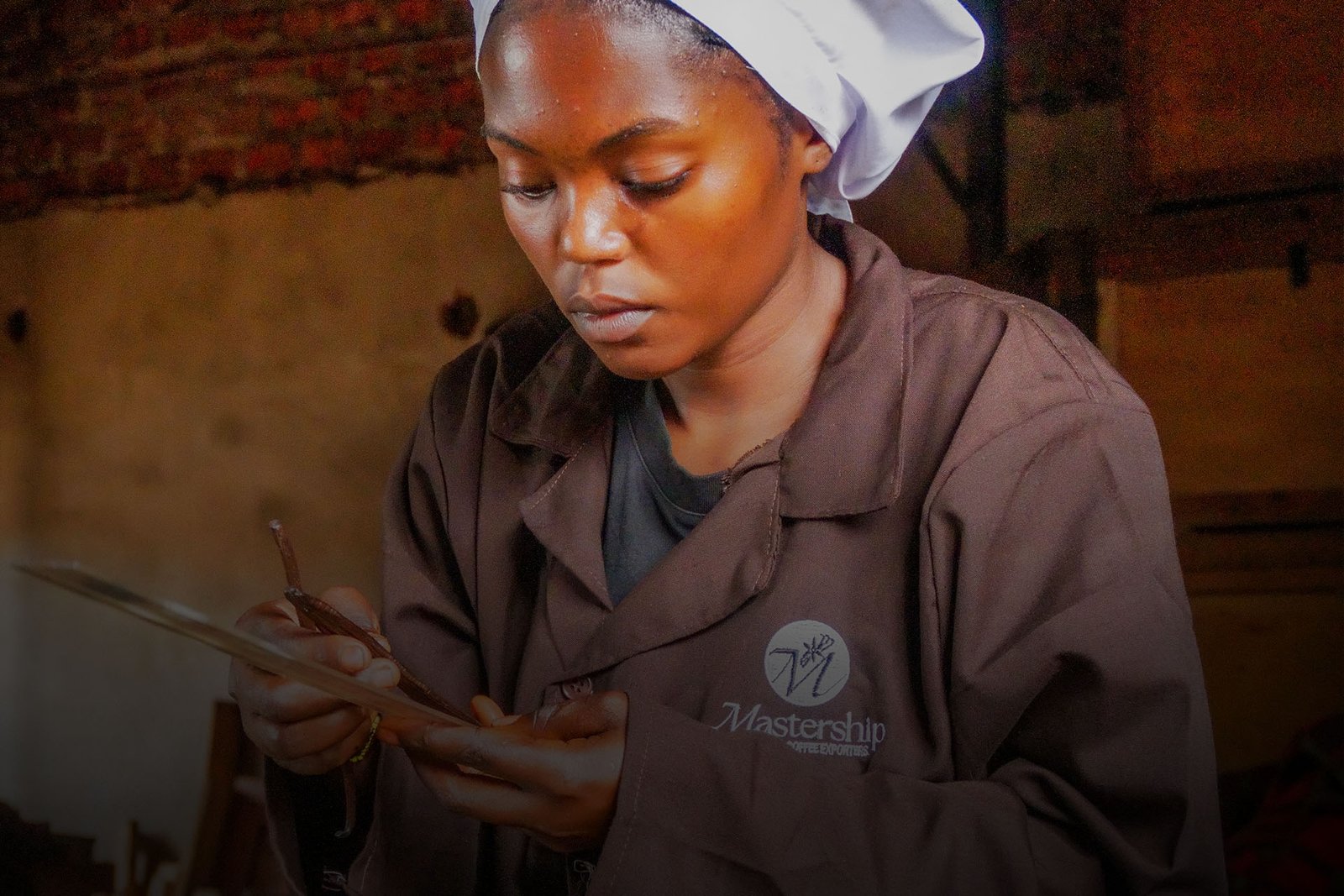
For vanilla to turn from odorless green to fragrant dark brown pods its always a process, not a one day but months of touching every pod that you will like at the end of the day.
LET’S GO THROUGH THE PROSESS;
1.HARVESTING
After pollination, it takes 9 months for beans to ripe, at this time, farmers harvest their beans with guidance from our field officers so they don’t harvest premature beans.
Ripe beans always have yellowish end tips and some split depending on the months at the time of harvest.
Since ‘’RESPECT FOR FARMERS AND COMMUNITIES’’ is one of our core values, our success has to benefit everyone behind the product therefore we give them a fair pay to improve their live hoods.
2.SORTING
At the collecting centers in the villages, we sort beans according to sizes and appearance, the long beans, medium beans, short beans are separated since they are treated differently at the time of boiling.
The split, broken and blemish beans are also selected to avoid any slight mistake SINCE we aim at Quality production
3. WASHING
Reaching at the company premises, all vanilla beans are hand washed thoroughly making them free from dust and then sun dried.
This has helped us reduce the risk of mold thought the process.
4. BOILING
Washed green beans are immersed into boiling water at a temperature (65°C–80°C) for 2-3 minutes this depends on the size of the beans so as to protect its texture.
This process stops vegetative growth and starts enzyme activity.
5.SWEATING
Immediately after boiling, vanilla pods are rapped in blankets and kept in insulated curing box at a temperature of (45°C–55°C) for a duration of 2-3 days to allow them turn dark brown to black.
At this stage, beans start to develop aroma and vanillin.
6. SLOW SUN-DRYING
The sun is highly important in vanilla production but it has to be regulated to avoid brittle beans at the end to the process.
Vanilla beans when removed from the curing box, are put under sunshine for 30mins – 1hr every day for a month, this helps to reduce moisture content, improves the aroma and stimulates the vanillin content.
7.SHADE DRYING
After a month of sun drying, vanilla bean pods are put on racks and monitored under a dry shade for 2 months until its moisture content is 25%-35% depending on its category. After attaining the desired moisture content, vanilla beans are picked and put in maturing boxes. Beans should be flexible, oily and not brittle
8. GRADING
Vanilla bean pods are graded according:
- Length
- Appearance
- Moisture
- Aroma
- Flexibility
These grades include,
- Grade A vanilla beans (Gourmet)
Its length should be (14-20) cm, moisture content (30%-35%), dark to dark brown in color, oily and flexible.
- Grade B vanilla beans (Extraction beans)
It should be whole beans not less than 10cm, moisture content (25%-30%) dark to dark brown in color, oily and flexible.
- Splits
This grade is so interesting and has the highest note of aroma (sweet, chocolate like). Its vanillin content is always 3% and above.
Split beans show a natural sign of maturity.
- Shorts and cuts
- Seeds and powder
9. CONDITIONING AND MONITORING
After grading, vanilla bean pods are put in maturing wooden boxes aligned with wax papers to stabilize and improve flavor.
The storage area must be dry and cool.
During this stage vanilla must be checked to make sure its free from mold and also allows it to breath so as to improve its aroma.
10.PACKAGING AND STORAGE (READY FOR EXPORT)
Ready vanilla for export is transferred from wooden boxes to export boxes, aligned with a clear bag and wax papers to avoid external moisture from damaging our beans and also keep the aroma within.
By Pola
Mastership Vanilla, Cocoa and Coffee Exporters